
Boone County Owner-of-Record Card
Start with the Boone PVA Property Search, the official assessment-roll lead for Boone County. The Current Owner field on its results is only the beginning. Save it alongside the PIDN and both address types rather than copying the name alone. The full set is what makes a parcel record useful later. Free Basic Search covers the basic lookup by address, parcel ID, or owner. Subscription services go further. They advertise previous owners, sales history, legal descriptions, building details, photographs, and tax information. Free or paid, the PVA remains the authoritative starting point. It identifies the owner of record in Boone County.
| Owner Name | The PVA Current Owner text, including suffixes or entity wording |
|---|---|
| Mailing Address | Where assessment and tax correspondence is sent |
| Situs | The physical property address used for the search |
| PIDN | The exact parcel key shared with GIS and other county records |
| Last Sale Date | A transfer clue, if displayed in accessible detail |
| Deed Reference | Book/page or instrument clue for the Clerk record |
This card names the current owner of record for assessment purposes only. It is not proof of who lives there. The mailing address may point to a trustee, an entity, an agent, a lender, or an owner living outside Boone County, so preserve it strictly as a correspondence clue.
Date Boone County Current Owners
Boone County real property is assessed as of January 1 under KRS 132.220. The sheriff states that a tax bill is issued to the January 1 owner, even when a new deed later records. That annual snapshot explains why the bill, assessment roll, closing papers, and Clerk index can show two names during the same year.
Compare three dates: the sale or closing date, the instrument's recording date, and the roll's effective date. A recently recorded deed can beat the tax roll as evidence of the newest grantee. PVA updates still matter, but their purpose and timing differ from the recorder's daily documentary trail.
Recent sale check. The Boone County roll can lag a closing. The newest recorded deed is the more current ownership source when the parcel and legal description match.
Separate Boone County Owner Addresses
Two addresses serve two jobs. The situs address locates the land itself. The mailing address routes notices. Boone County's official street index shows a city label, road jurisdiction, ZIP, and city-limit line can all differ along the same street, so none of those pieces should collapse into one field. Keep the physical address, mailing address, PIDN, and legal description separate.
Only the current owner can change the mailing address in the PVA system, and an entity needs authorization. That restriction makes the field dependable for lawful correspondence. It still says nothing about occupancy. An owner may use a business office, a trust address, or an out-of-state destination.
Note: A mailing address is a contact clue, not evidence that the current property owner lives at or away from the parcel.
Confirm Boone County Current Owners
Confirming the current owner means moving from the PVA record card to the latest deed. Match the same land, not just the same name. Boone County deeds may describe a parcel by subdivision, lot and block, or metes and bounds instead of a street address, so read the legal description closely.
- Search PVA by the situs address and copy the Current Owner and exact PIDN.
- Use the name as grantee in the Boone County Clerk land-record search.
- Open the newest acquisition deed and compare its legal description and deed reference with the parcel.
- Check the recording date against the January 1 roll and any recent sale date.
- Owner of record
- The party named on the assessment roll.
- Assessment roll
- The PVA's list and valuation of taxable parcels.
- Recording lag
- The gap between a deed recording and a later roll update.
- Vesting
- The way the instrument places an interest in the named grantee.
Check Boone County Entity Capacity
A roll can name an LLC. It can also list a trust, a trustee, a personal representative, or a life tenant. Search an entity by its full name in the PVA. The Kentucky business search then offers filing status and agent clues. The state filing helps identify the entity. The deed still proves the parcel link.
Trust and estate language demands care. A trustee's name may appear alongside the trust. A deceased owner can stay on the roll until a qualifying record is filed. PVA requires an official deed or will recorded with the proper office. A death certificate submitted to PVA also works before it corrects a name. Read the capacity listed after the name instead of trimming it away.
Boone County Prior-Owner Gate
PVA's free Basic Search is enough to start a current-owner lookup. The subscription page places current and previous owners, sales history, legal descriptions, and photos inside paid plans. Building facts and more detailed tax data sit behind the same paywall. Those plans span roughly 50,000 parcels, with a day-pass option and recurring access both available.
Paid detail saves time, but it never converts assessment data into a title opinion. An older owner is sometimes the real goal. The Boone County previous-owner trail lives in the grantor-grantee chain. The current-owner lookup ends at the newest matching conveyance.
Inspect Boone County PVA Access
The official PVA portal shows the access point for the current owner query.
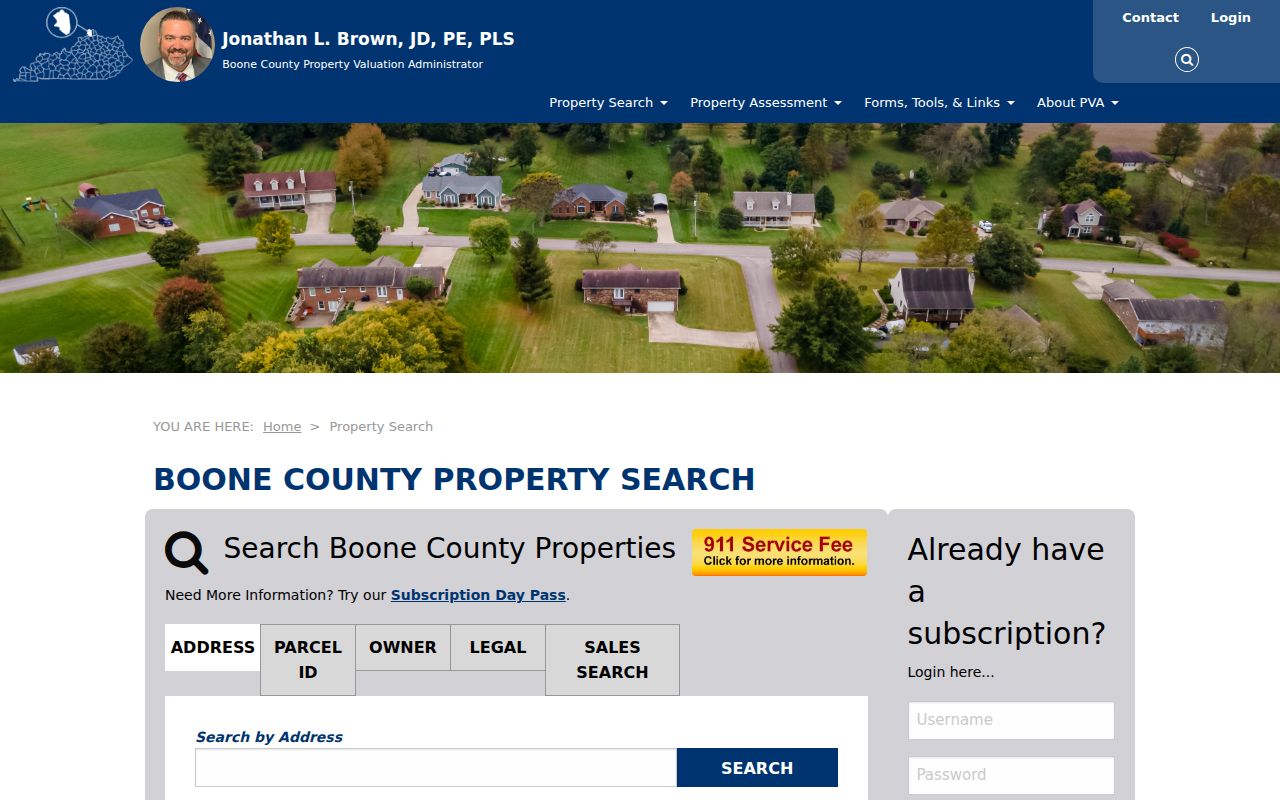
The PVA search page leads to the roll card. The newest matched deed settles any date conflict or recent transfer.
Request Boone County Owner Proof
Online tools do not replace office access. PVA staff can clarify the assessment field. The Burlington office can help by phone, email, mail, or an in-person visit. The County Clerk Real Estate Department offers several routes. Options include eCCLIX access, a physical record room, mail service, and an email request route. Ask the Clerk about certification and the current charge for copies. When requesting, supply the PIDN, party name, instrument or book/page, and preferred format. Older deed books may require the counter or SB2/SB3 series images. If routine access does not cover a requested agency record, Kentucky Open Records Act procedures under KRS 61.872 offer an inspection path. That path is subject to lawful exemptions.
Correct Boone County Owner Names
Fixing a wrong or outdated name on the roll takes evidence. Editing a search phrase does nothing. Per the PVA's FAQ, a deed or will must be recorded with the proper office, or a death certificate filed with the PVA, before the current owner field changes. That rule keeps the name tied to records the office can verify in Boone County property records.
Start with the PIDN and legal description. Confirm both point to the right parcel. Then compare the name character by character across the PVA entry and the latest Clerk instrument, watching suffixes, initials, trust capacity, and entity punctuation. A different mailing address is not an error. A new tax-bill recipient does not prove a deed changed either.
Business owners call for the state entity record first. Get the correct legal name before contacting the PVA. For an estate, find the recorded fiduciary instrument or qualifying court record. Keep copies of each source, its date, and any submission receipt so the correction trail can be audited later.
Rank Boone County Owner Evidence
Not every owner display carries equal weight. The PVA current owner field is the best fast lead on the assessment roll. A GIS label helps confirm that the polygon and PIDN you selected are right. The recorded deed adds grantor, grantee, date, and legal description. That is what you need to test a recent transfer in a Boone County property search.
Some sources answer narrower questions. A tax bill serves collection and may still carry the January 1 owner. A Secretary of State filing describes a business entity, not its land. A probate docket shows authority or estate process. But the land record holds the instrument that changed the parcel. Rank each source by the question it was built to answer.
When two sources conflict, never merge names. Capture both, note their dates, and hunt for the newest deed matching the parcel description. A later correction deed, fiduciary deed, or other recorded instrument may explain the gap. If no document settles it, ask the custodian. Never present an uncertain current owner as fact.
Use Boone County Owner Records Lawfully
The public mailing address supports lawful uses. A parcel question, purchase inquiry, boundary notice, or estate matter all qualify. Keep contact tied to the land itself, and respect any request to stop. Kentucky's Safe at Home program can substitute an address in many public records, though it treats real-estate purchase and sale records as an exception.
Lawful use. Boone County current owner data supports legitimate property research. Never use a public name or address to stalk, target, or harm anyone.
A current owner result is not a title search, occupancy record, or survey. When legal rights depend on the answer, obtain the instrument and use qualified professional help.