
Trace Boone County Former Owners
Anchor the hunt in the newest deed that matches both the PIDN and the full legal description. The deed must match the full legal description too. Then build a simple row for each transfer. Step backward from grantee to grantor one instrument at a time. Treat the dates and names as a blank pattern, not as sample Boone County parties. Never patch a gap by assuming a shared surname means the same owner of record.
| Transfer Date | Grantor to Grantee | Deed Type | Book/Page |
|---|---|---|---|
| Newest matched recording | Named grantor to current grantee | As indexed | Copy exact reference |
| Prior matched recording | Earlier grantor to later grantor | As indexed | Copy exact reference |
| Next earlier recording | Repeat the backward link | As indexed | Copy exact reference |
The legal description is your control column, even when a compact timeline leaves it offscreen. At every step compare subdivision, lot, section, metes-and-bounds calls, and acreage. Streets get renamed. The land description does not.
Boone County Deed-Coverage Bands
Boone County's online cutover is a band, not a single year. The Clerk's current record-room sheet treats deed book D482 as the beginning of the indexed and imaged era. That book starts in 1992. Books D170 through D481, spanning 1965 to 1992, exist as scans only. For anything older, eCCLIX instructions point to the alphabetic SB2 and SB3 series images. Those images reach back to 1960. Scanned-only is not the same as name indexed. A former-owner search may send you to the direct or indirect index. Or it may point to a book code and page or an alphabetic series image instead of a modern search box. Check the Boone County Clerk search instructions for exact coverage. Do not read a blank result as proof no deed exists.
Online cutoff warning. Indexed deed searching begins with D482, while older scanned and series-book runs need another path through images, books, or the Clerk counter.
Reach Boone County's Early Deeds
Boone County was organized in 1799. The Kentucky Department for Libraries and Archives county table shows Boone deed coverage from 1799 through 2015. That reaches far deeper than the modern indexed band. Work the Clerk's deed books and older indexes first. Then ask KDLA about archival or microfilm holdings once the local route runs out. The Boone County Public Library Archive and History Center brings maps, family collections, local newspapers, and staff who know the territory. Its Boone County Recorder run starts in 1875. It can surface sale notices, estate context, old road names, and house-history leads. Clues like these point toward a deed. They never replace the recorded transfer itself. Note: Record exact book, page, image, index spelling, and source location so anyone can retrace each backward step.
Reconstruct Boone County Deed Chains
The chain begins in the present but always runs in past tense. Locate the current owner of record's acquisition deed as grantee. Turn that deed's grantor into your next grantee search. Keep the PIDN, deed reference, and legal description beside every name you add.
- Find the current PVA parcel and copy its PIDN and latest deed clue.
- Locate the current grantee's acquisition deed in the Clerk index.
- Read that deed's grantor, legal description, type, date, and book/page.
- Search the grantor as a grantee in an earlier date range, then repeat.
- At the indexed cutoff, shift to scanned books, SB2/SB3, counter indexes, or archives.
- Grantor
- The party conveying the stated interest.
- Grantee
- The party receiving the stated interest.
- Chain of title
- The linked sequence of instruments affecting the land.
- Reverse index
- The grantee-side index used to find how a prior owner acquired the parcel.
- Quitclaim and warranty deed
- Different conveyance forms whose legal effect must be read from the instrument.
Resolve Boone County Chain Breaks
A tidy sale-to-sale sequence can snap at probate, a life estate, a correction deed, a name change, a trust conveyance, a foreclosure, or a parcel split. When an owner dies, the estate may generate a court file and a personal representative before any fiduciary deed reaches the recorder. The PVA may keep the prior name until a deed, will, or death certificate justifies a correction. For a split or combination, weigh old and new PIDNs, plats, acreage, and legal descriptions against each other. An instrument conveying part of a tract is not a transfer of the whole parcel. A foreclosure sale listing is not the final deed either. Confirm the later instrument actually recorded with the Clerk.
Keep Boone County Land Aligned
Recorded plats keep past owners tied to the same lot. Streets, parcel numbers, and subdivision phases can shift over time. The plat holds the lot steady. Boone GIS exposes Communities, Plats, and Property Subdivisions layers. They carry plat IDs, subdivision names, sections, and subsections. Treat those map layers as finding aids. For anything you must rely on, pull the recorded plat and the deed itself. In a platted development, compare lot, block, section, and phase. Rural land asks for more. Follow the bearings, distances, monuments, creeks, roads, and adjoining tracts inside the metes-and-bounds description. That discipline keeps a similar surname on nearby land from creeping into the wrong chain.
View Boone County Plat Metadata
The county's subdivision and plat service lays out the map-side fields that help align old deeds.
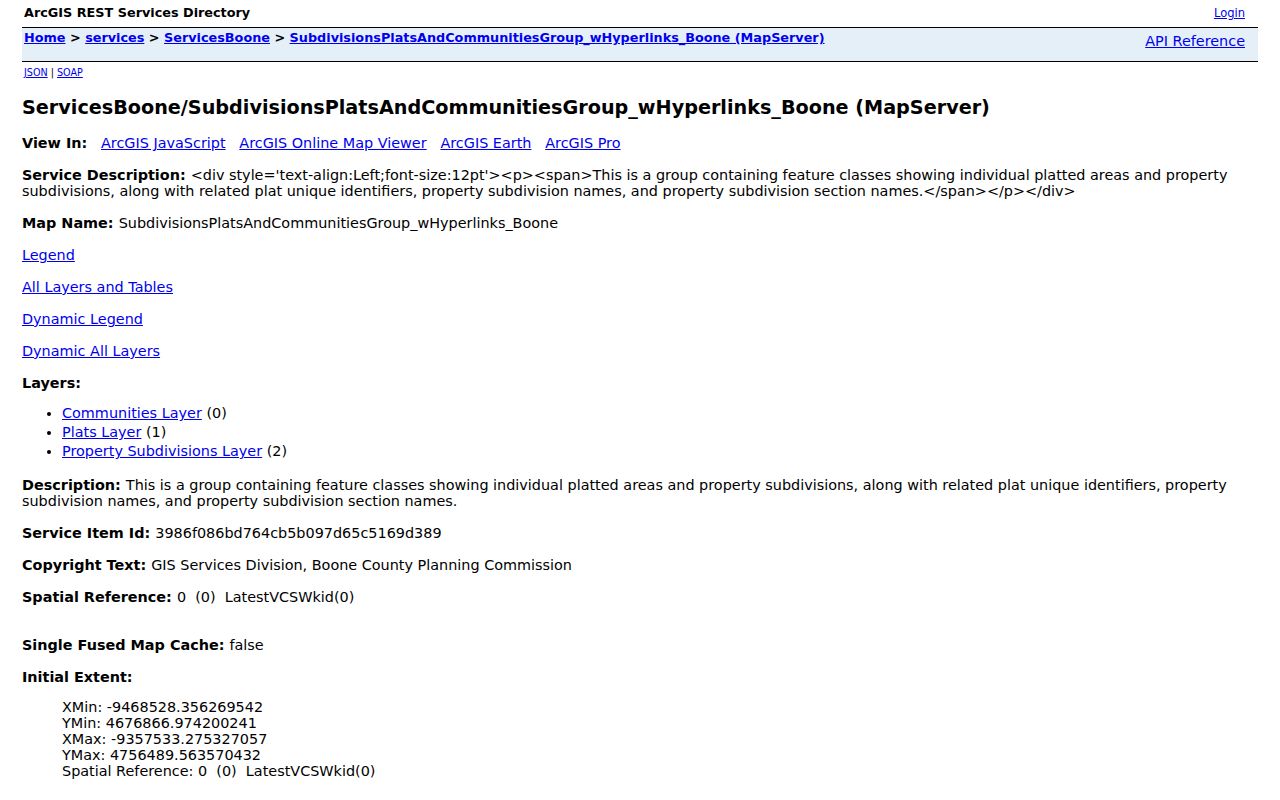
That map service supports the plat cross-check, while the recorded Clerk instrument stays the authority for each transfer.
Request Offline Boone County Chains
The Boone County Clerk Real Estate Department serves researchers through the record room, mail, and email requests. eCCLIX offers another route. Include party names, a date band, book and page, document type, PIDN, and legal description. Cover all of these in any request. Current copy and certification charges are not posted on the accessible official pages. Ask before ordering. For older chains, keep going through the Clerk. KDLA, the Boone County Public Library, and the Kentucky Historical Society catalog also help. Routine channels may not produce an agency record. In that case, a focused Kentucky Open Records Act request under KRS 61.872 can seek inspection, subject to exemptions. A specific deed book answers most questions better than a broad request ever will.
Follow Boone County's Spiral Plat
Burlington hides a useful clue for anyone tracing former owners in Boone County. The county seat began as Wilmington, platted in 1800. Lots spiraled around the Public Square in the early plan. Burlington never incorporated as a city, though. Keep the search inside Boone County property records rather than a municipal system.
An old lot number may look nothing like a modern address or PIDN. The spiral plat is only a starting point. Prove each ownership link with deed books, recorded plats, legal descriptions, and adjoining-owner calls. A modern parcel map can help you find the general area. Just do not force it to match an early diagram without documentary support.
Local newspapers and archival maps often explain a vanished place name or an old road. They can also explain an estate notice. They work best as pointers. Trust the recorded instrument. Let each lead return to a dated deed, probate file, or plat entry. That record restores the ownership chain.
Audit Boone County Prior Owners
A solid chain log captures more than a surname. Record each owner's role as grantor or grantee. Add the instrument type, recording date, and book/page or document number. Save the exact legal description along with the source image or office. Note spelling variants without changing the index entry.
Test every link in both directions. The current deed should name the prior owner as grantor, and an earlier deed should show that same party receiving the same land as grantee. If acreage, lot, or subdivision changes, pause and locate a split, combination, plat, or partial conveyance. Read quitclaim deeds closely, since the label alone does not say what interest existed.
Keep fact and clue separate in the log. A tax roll or map label can guide you. The recorded instrument, not the clue, supplies the transfer evidence. Mark any unresolved span plainly. That keeps the Boone County ownership history useful without turning a probable link into a false claim.
Measure Boone County Ownership Depth
KDLA's table places Boone deeds at 1799 through 2015. Current Clerk holdings carry the record forward from there. That does not mean one portal offers a seamless name search across the whole span. Former owners surface through indexed current deeds, scanned-only books, alphabetic series images, direct and indirect indexes, and archival copies.
Research boundary. A reconstructed Boone County deed chain is not a title opinion. Use former-owner records for lawful land history and diligence, never to track or harass a living person.
Stop where the evidence stops. A missing online name hit is not a missing owner. It may reflect scanned-only material, an entity variant, an estate transfer, or a changed parcel, and a professional title examination is appropriate when rights, priority, or insurability depend on the chain.