
Three Boone County Property Values
Boone PVA assesses real property under Kentucky's 100 percent fair cash value standard. That number exists for the tax system. A recorded deed may state its consideration. Consideration is the amount given for a transfer, while a private market appraisal answers a different question at a different date. Keep the source and effective date beside every figure.
| Value | What It Is | Where |
|---|---|---|
| Assessed value | PVA fair-cash-value figure used in property taxation | Boone PVA assessment roll |
| Market value opinion | A date-specific estimate prepared for a private purpose | Licensed appraisal, not the tax portal |
| Last sale price | Consideration or transfer amount from an earlier transaction | Recorded deed and limited PVA transfer history |
| Land and improvement values | Components that help explain the assessment total | PVA parcel detail when available |
The figures may line up. Nothing requires it. A sale can carry unusual terms, multiple parcels, family consideration, or property conditions the roll treats differently. An assessment may also predate a recent transfer, so read the deed language before calling its amount a clean market sale.
Match the question to the source. For public tax value, use PVA. For a transfer's stated amount, use the Clerk's instrument. For a current opinion built around the building, land, date, and intended transaction, use a qualified private appraisal. Mixing sources produces a precise-looking number with the wrong meaning.
Boone PVA Value Fields
The Boone PVA Property Search offers a free Basic Search. You can search by address, street, owner, or PIDN. Basic results supply the current roll lead. The PVA's paid service goes further. It adds detailed sales and legal descriptions. It also includes photos, characteristics, current and previous owners, transfer history, and property-tax information. Its signup material says the paid service covers about 50,000 parcels.
That access split matters. A Boone County property value search can return less detail than expected. A missing prior sale in Basic Search is not evidence that no sale occurred. Use the parcel ID to reach the Clerk's recorded instrument. The roll serves valuation and administration, not a complete chain of title.
The official PVA access page shows the published subscription boundary. It also lists the detailed record features.
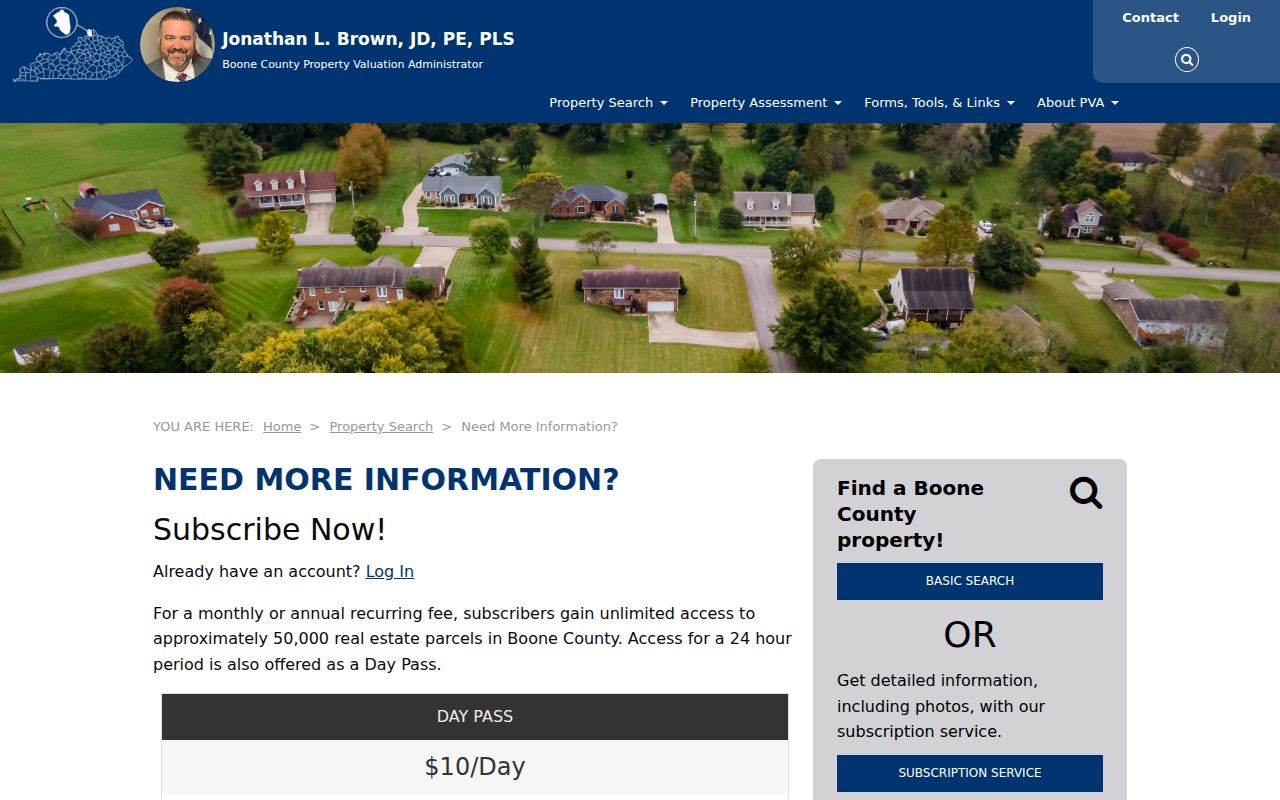
The screen shows why value and transfer fields can differ.
Kentucky Fair Cash Value
The local PVA applies Kentucky's fair cash value framework, and the state adds sales-assessment ratio studies and revaluation procedures under KRS 133.250. A ratio study compares assessments against qualifying sales. The comparison covers a group. It is not a parcel appraisal.
Read a Boone County assessed value as the public valuation for its assessment period. The number supports tax administration and broad equalization. Physical condition, a contract date, special financing, or later market movement can push a private opinion elsewhere. Those gaps do not make either source meaningless. They show that the sources answer separate questions.
KRS 133.250 also frames revaluation. It does not authorize multiplying one parcel's figure by a guessed ratio. Use the PVA's actual value field and current notices. A disputed figure belongs in the formal assessment process. Handle it with the tax-record page and the PVA, not improvised math.
Check a Boone County Assessed Value
Search by address first when the PIDN is unknown. The parcel number then becomes the stable key for comparing GIS maps, recorded deeds, and tax material. Save what the result shows. Record the assessment date, owner field, situs, mailing address, and any land or improvement breakdown.
- Open Boone PVA Basic Search and enter the full address, street name, owner, or PIDN.
- Match the situs and parcel identifier before copying the assessed value and its roll date.
- Retain land, improvement, exemption, and transfer fields only when the result displays them.
- Use the County Clerk record to read the actual deed and stated consideration.
- Compare dates and property identity before comparing the figures.
- Assessed value
- The PVA's fair-cash-value figure used in the tax process.
- Market value
- The likely price in an open market as of a stated date and under stated assumptions.
- Assessment ratio
- A comparison between assessments and qualifying sales across a group of properties.
- Consideration
- The value or payment stated in a deed. It may need context before being treated as a sale price.
- Reassessment
- A later review that can change a property's official value for a new assessment period.
Boone County Values Have Dates
The PVA roll and sheriff bill follow a January 1 assessment snapshot. The sheriff issues the bill to the January 1 owner and receives no later transfer data for it. A deed recorded afterward can show a new grantee. The tax document may still name the prior owner.
The same timing affects value work. Dates matter. Record the assessment year, deed date, recording date, and sale date when available. A value and a sale separated by many months are not simultaneous evidence. The PVA inspects and updates property. No single Boone-wide lag fits every change.
Note: A correct parcel number does not erase a date mismatch; always label each value with its source year.
Boone Land and Improvement Values
Every Boone assessment splits into two parts. Land covers the site itself. Improvements capture structures and other assessed additions. A recent sale, permit, or new plan is not proof the tax roll already reflects every physical change, so check the current parcel record and any PVA inspection or assessment notices.
Boone County is not one uniform market. Florence's established streets and retail corridors, Union's expanding subdivisions, Walton's cross-county edge, and rural tracts can follow distinct record histories. Match use, location, tax district, lot or acreage, and assessment period before comparing two parcels, because county growth is context rather than a valuation method.
Planning records often explain why an improvement field changes. The files name projects, addresses, phases, and lot counts. GIS supplies zoning and appraisal context alongside them. Those documents describe proposed or reviewed work. Confirm completion and the current parcel record before tying a plan to a higher assessment. A permit application alone never proves the work was built.
Recorded Sales and Boone Values
The deed record kept by the Boone County Clerk documents each transfer. Search the current grantee and grantor first. Then match the legal description, PIDN, book and page, or instrument reference. The PVA labels its free transfer history as limited. Paid access supplies more sales detail. Neither summary should replace reading the deed itself.
Some transfers are not normal open-market sales. Estate deeds, corrections, life-estate changes, quitclaims, multi-parcel instruments, and transfers between related parties can carry amounts that need careful interpretation. A recorded amount is historical evidence. It does not guarantee a current Boone County property value.
Use the legal description to confirm the deed and assessment cover the same land, since street addresses change and one deed may span more than one PIDN. Capture book and page or instrument number, grantor, grantee, recording date, parcel key, and consideration together, and the comparison becomes reproducible.
Exemptions Change Boone Taxable Figures
Homestead or disability treatment changes the taxable amount. It does not answer the underlying market question. The PVA publishes application tools and eligibility material. An exemption flag belongs in the tax calculation, not with any claim that the property itself has a lower open-market value.
Keep assessed value, exemption, taxable amount, and bill amount in separate fields. The Boone County property-tax record covers bills, collection, and appeal steps; value research stops at what each valuation number means and where it is recorded.
Boone Districts Add Tax Context
The state property-tax rate book lists county, school, fire, city, and special-district rates. Equal assessed values can still produce different tax totals. A rate does not change what the assessment means. Establish the parcel, valuation year, exemption status, and tax district first. Only then does a rate comparison help.
Boone GIS publishes city, fire, school, library, and tax-entity layers as map context. A line near a parcel can be hard to read. Confirm the district on the official bill or with the responsible office instead. Walton crosses a county line. A postal city is especially weak evidence for tax jurisdiction. Rely on the PIDN and legal location.
The sheriff collects current Boone property taxes. Unpaid bills transfer to the County Clerk after the stated April handoff. Those offices answer collection questions, not the valuation question. A penalty, delinquency, or later payment never changes the PVA's assessed value. These records describe different stages of one tax system.
Build a Boone Value Evidence File
A strong evidence file for Boone County property values stays small and exact. Pull the PVA result first. It should show the PIDN, situs, roll date, owner of record, land value, improvement value, any exemption, and the total. Then pull the deed reference. Capture the grantor, grantee, consideration, recording date, legal description, and any multi-parcel language in the instrument. Add GIS or planning records only when they help explain the location or the improvements themselves.
Boone Value Record Fallbacks
Basic Search sometimes runs thin on detail. The PVA office can fill gaps by phone or at its Burlington counter. For deeper fields, the official signup page sells a day pass plus longer subscription tiers. Paid access opens more transfer, owner, photo, characteristic, legal, and tax detail. It still does not make the assessor a recorder, though, so deed evidence lives elsewhere.
That evidence sits with the Boone County Clerk's Real Estate Department. Requests go through eCCLIX, the counter, mail, or email. Name the grantor, grantee, recording date, document type, and either book and page or instrument number. Add the parcel key and say whether certification is needed. Older series may force a scanned book or a physical record-room search. Confirm current copy and certification fees with the Clerk before relying on any figure.
Value shifts after physical work tell another story. Boone Planning or Building can supply the application, plans, approvals, inspections, and closeout. Use the address and PIDN. Florence, Union, and Walton may hold municipal files too. That depends on the parcel and the issue. Walton needs a county check because the city straddles Boone and Kenton lines. A city file explains administrative history; it never sets the county assessment.
The Kentucky Open Records Act opens one more door. Written requests reach non-exempt records held by a public agency. Keep the date span narrow and name an existing record rather than a wish. The law will not make an agency produce a private appraisal. Nor will it force a fresh property value calculation. A request only returns the data behind a decision. That holds where the agency keeps it and disclosure is allowed.
Boone County Value Record Limits
The assessment roll never inspects every private fact behind a possible sale. It cannot promise a contract price. It cannot settle a condition dispute or stand in for a lender's or buyer's appraisal. Treat GIS appraisal fields as reference data. Check them against the PVA record before use.
Use each official Boone County property value only for the purpose and date its custodian states. A recorded deed remains the proof of transfer. When a current, property-specific market opinion matters, bring in a licensed appraisal.
Value is not price. A Boone County assessed value supports taxation. It is not a guaranteed sale price and is not a private appraisal.